Squamish's new council just held its first real meeting. Here's everything that happened
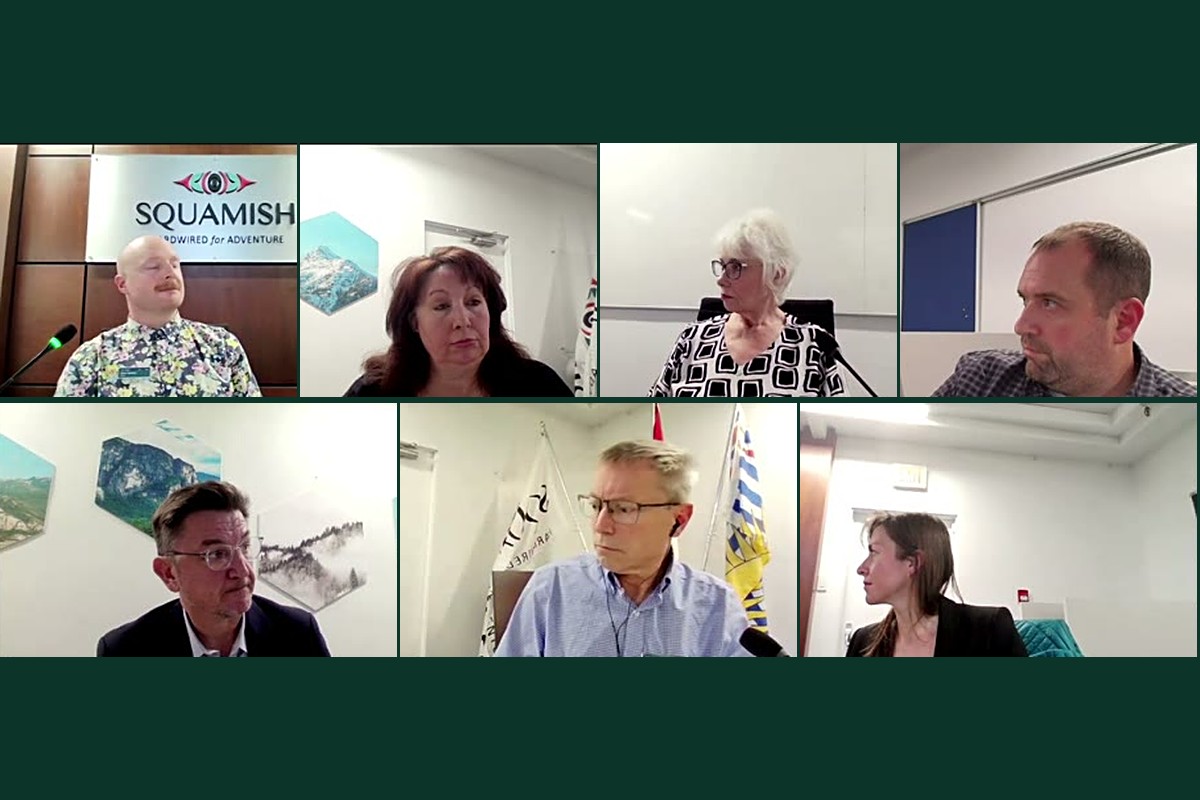
The new council's first full meeting: a property tax freeze plan, a 4 to 2 split on co-living homes, steep slope rules and a flood plan grant. Every decision, who said what, and how to weigh in before December 1.
In plain words
- Mayor Sean Easton wants the District to collect no more property tax in 2027 than it did in 2026; on December 1 council votes on whether to send staff back to rework the budget, and you can write to council@squamish.ca before then.
- Staff say the current draft adds about $382 a year to the District part of an average home's bill, so a freeze means finding $6.3 million through higher fees, cuts or reserves, and new projects would wait until spring.
- Council voted 4 to 2 to give business licences for co-living homes, where people rent rooms and share a kitchen, three of the four votes a bylaw needs; council's vote to adopt it comes at a later meeting. The mayor declared a conflict of interest, left the room and did not vote.
- New steep slope rules and a flood plan grant passed with no one opposed.
Every decision
Each topic below shows how all seven voted. A red edge means the vote was split. Tap Read more for the details.
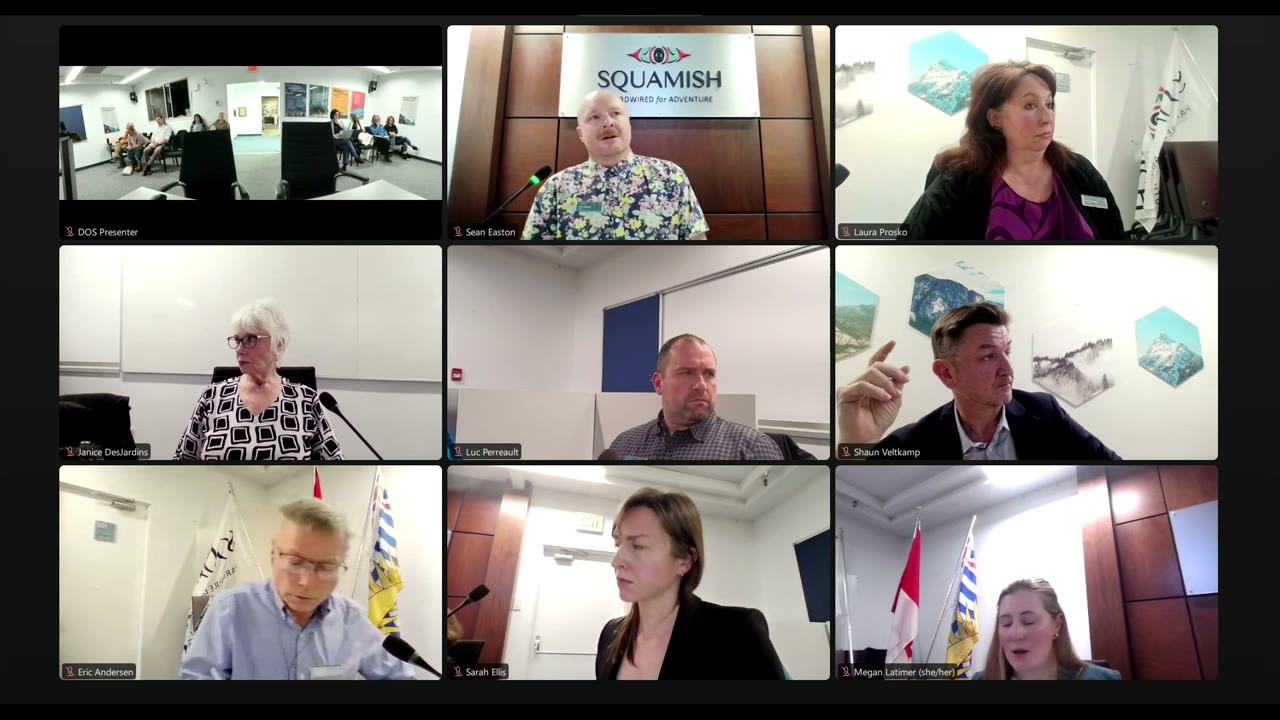
The tax freeze
No vote yet. Staff say a freeze means finding $6.3 million. Three members campaigned on a freeze; others urged caution or a slower path.No vote yetMayor's motion for a 2027 budget with no property tax increasePassed unanimouslyStaff memo on the cost and timing of a tax freeze ✓
 ✓
 ✓
 ✓
 ✓
 ✓
 ✓
In short: The mayor wants no increase in District property tax for 2027. Staff say the draft adds about $382 to an average home, so a freeze means finding $6.3 million in fees, cuts or reserves. Council votes December 1 on whether to send staff back to rework the budget, and three of the seven campaigned on a freeze.
No voteMayor's motion for a 2027 budget with no property tax increase
What it means for you: The current draft budget would add about $382 a year, or $32 a month, for an average home assessed at $1.2 million; the motion asks for no increase.
Squamish council heard Mayor Easton's notice of motion asking staff to bring back a revised 2027 budget with no increase in property tax revenue over 2026, while keeping or improving services and avoiding layoffs. No vote was held; council will debate it on December 1. Staff said a freeze would likely require service cuts, job cuts, higher fees or drawing on savings, and would put new projects on hold until a new budget is adopted.
Part of: 2027 budget and property tax increase
Why it matters: It could decide whether property taxes go up in 2027 and what services might change.
Passed All 7 there agreedStaff memo on the cost and timing of a tax freeze
Squamish council voted to ask staff for a written memo for the December 1 meeting on the timeline, costs and effects of the mayor's budget motion, including smaller or phased options and what work would be put on hold. Councillor Ellis moved it and Councillor Veltkamp seconded it. No one was recorded as opposed, though Councillor DesJardins said she felt it was not needed and Councillor Perreault worried about overloading staff.
From the meeting video. We check it against the official minutes when they come out, usually a few weeks later. Under B.C. law, a member who is in the room and does not vote is counted as voting yes (Community Charter section 123(4)).
Part of: 2027 budget and property tax increase
Why it matters: It gives council more detail on the trade offs before deciding on a property tax freeze.
Mayor Easton's motion asks staff to rework the draft 2027 budget so the District collects no more property tax than in 2026. It also says services residents use must stay the same or get better, with no layoffs, no cut in union staff hours and no extra contracting out. Savings would come from a review of how the District is run, led by the chief administrative officer, with input from staff, unions and residents.
Why he wants it. "It's our turn to tighten our belts, like so many residents have had to in Squamish," he said, calling for "a leaner, meaner and more accountable government." He cited the District's own resident survey: only 37% of residents felt they get good value for their municipal taxes, and 58% said quality of life had dropped over five years. District tax has also climbed fast: compounded, the yearly increases from 2022 to 2026 put the total about 61% above 2021 (our arithmetic), though part of that came from new buildings joining the tax roll.
What happens December 1. Under council's procedure bylaw, a notice of motion comes up at the next regular meeting. Council can pass it, change it, send it elsewhere or defeat it. Passing it would send staff back to rework the draft; the budget itself is set later by bylaw. Three of the seven members campaigned on a 2027 freeze (Easton, DesJardins and Prosko), and a motion needs four votes when everyone is there; a 3 to 3 tie fails.
Where each member stands. Nobody voted on the freeze itself. Here is what each member said.
| Member | Campaign promise | What they said on November 17 |
|---|---|---|
| Mayor Sean Easton | Freeze in 2027 | Brought the motion. "It's our turn to tighten our belts, like so many residents have had to in Squamish." |
| Councillor Laura Prosko | Freeze in 2027 and 2028 | Wants it debated December 1; asked whether staff could cost both a zero and a modest increase |
| Councillor Janice DesJardins | Freeze in 2027 | Backed the mayor bringing it forward; said the extra memo motion wasn't needed |
| Councillor Eric Andersen | No freeze promise | Supports debating it December 1 and getting the staff memo first |
| Councillor Sarah Ellis | No freeze promise | Asked staff for other ways to reach the goal without delaying the budget as much; moved the memo motion asking for scaled or phased options |
| Councillor Shaun Veltkamp | No freeze promise | Can't support a freeze "straight out of the gate"; open to working toward zero over the next year |
| Councillor Luc Perreault | No freeze promise | Worried about changing too much at once; suggested keeping course for year one and working on changes alongside |
What the draft means for your bill
Type in the District of Squamish part of your 2026 property tax notice. We start with the average home, $3,294. Renting? Your landlord pays this; see the note below the calculator.
On your notice it's the District of Squamish (municipal) line. Don't count school, regional district or hospital taxes, which are set separately. What you type stays on this phone or computer.
- Tax freezeThe District's total tax stays at 2026. Your own bill can still move a little with your assessment and new buildings joining the tax roll0%
- Example: a 5% increaseOur example of a smaller increase, like the scaled options council asked staff to cost5%
- Current draft budgetStaff's November 17 figure: about $382 on the average home11.6%
Staff gave $382 on the average $1.2 million home; $382 out of $3,294 is 11.6% (our arithmetic). The District's total tax collected rises about 11.5%. In the September draft, each 1% of tax was about $546,000 (our arithmetic). Renting? BC limits rent increases for current tenants to 2.2% in 2027, whatever happens to property tax.
Want your whole bill, including school, regional and hospital taxes? Try our Squamish property tax calculator.
Renting? You don't get a tax notice, but your landlord pays it. BC limits rent increases for current tenants to 2.2% in 2027, so a tax rise generally can't be passed on above that. The limit doesn't apply when a new tenancy starts. Some of the ways to close the gap, like higher recreation fees or smaller community grants, would reach renters directly.
What staff say it would take. The District's chief financial officer laid out the numbers. The draft collects about $61 million in property tax for daily services and repair savings, $6.3 million more than 2026. That's about $382 a year, or $32 a month, on an average home assessed at $1.2 million. Provincial law requires a balanced budget, so the District can't run a deficit: every dollar of a freeze has to come from somewhere.
| Part of the increase | About |
|---|---|
| Already committed: transit contract, union wages and benefits, police, other signed contracts like software | $3.6 million |
| Yearly saving toward fixing and replacing roads, pipes and buildings | $1.3 million |
| Firefighters | $350,000 |
| New union positions | $300,000 |
| Non profit partners | $50,000 |
| Smaller items to keep services as they are, or judged critical | about $700,000 (our arithmetic: what's left of $6.3 million) |
| Total, compared with 2026 | $6.3 million, about $382 a year on an average $1.2 million home |
About $3.6 million of that is already committed, mostly by contracts. So a freeze can't come from trimming this year's increase alone; staff would have to look at the whole operating budget.
| Option | What staff said |
|---|---|
| Raise fees | Business licences, building and inspection, recreation admission and passes, facility rentals, development permits |
| Draw on reserves | Staff listed drawing on reserves (money set aside) among the options, without a dollar figure |
| Cut services or positions | Unless a job is already empty, cuts mean severance, and many contracts carry termination costs, so the first year saves less. The mayor's motion rules out layoffs and cuts to services residents use |
| Cut community grants | Grants to non profits under the community grants policy |
| Drop tax funded special projects | About $400,000 in 2027, including the first year of the community plan update and the climate action group |
| Use tax from the District's single large taxpayer for daily costs | That taxpayer is Woodfibre LNG (liquefied natural gas), whose roughly $7.24 million is kept out of the daily budget by policy. Using it would mean changing the tax policy and having less for future capital projects |
| Save less for repairs | Staff advised against it: underfunding repairs "will most certainly cost the taxpayer more in the long run" |
The mayor's motion rules out layoffs and cuts to services residents use, so the main levers it leaves are fees, grants, special projects, reserves and the efficiency review.
Timing. If the motion passes, staff set the current draft aside while they rework it. Projects and purchases that haven't started would wait until a new plan is adopted, likely the end of March, which staff said shortens 2027 work plans by about a quarter. By law the financial plan comes first and the tax rate bylaw must be adopted before May 15.
The review. The general manager of corporate services said reviews like the one in the motion usually take about a year, cost about $100,000 and are not usually done just to cut a budget. The last one started in 2019 and was finished in 2020. The chief administrative officer has announced their retirement, and staff noted a new one often reviews staffing structures anyway. The mayor answered that he isn't asking for a long review: he wants the people "closest to the issues" to find the savings.
Councillor Ellis then moved that staff write a memo for December 1 on the timeline, costs, work put on hold and scaled or phased options. It passed with no one voting against it. DesJardins said she felt the extra motion wasn't needed, and Perreault worried about loading too much on staff at once.
Your say
What should council tell staff to do with the 2027 draft budget on December 1?
The draft adds about $382 a year to an average home. A freeze means finding $6.3 million.
Co-living homes
Three readings passed 4 to 2; adoption still to come. DesJardins and Perreault voted no and the mayor stepped out. Check whether your street's zone allows it.Passed 4 to 2Business licences for co-living homes–✓✕✓✕✓✓Failed 2 to 4Proposal to send co-living and workforce housing questions to strategic planning–✕✓✕✓✕✕
In short: Licences for homes that rent rooms around a shared kitchen moved ahead 4 to 2, which lets fire and building staff inspect them. DesJardins and Perreault wanted more public input on parking and safety first; the others said inspections shouldn't wait. Council still has to vote to adopt the bylaw at a later meeting.
Passed 4 to 2 (1 stepped out)Business licences for co-living homes
What it means for you: Co-living owners would pay a licence fee of $130 a year, rising to $160 in 2027.
Squamish council voted 4 to 2 to give first, second and third reading to a bylaw that adds co-living homes to the District's business licence rules. This lets the District issue licences to co-living owners and lets fire and building staff inspect them. Councillors Perreault and DesJardins voted against, and Mayor Easton left the room because of a conflict of interest.
EastonFrom the meeting video. We check it against the official minutes when they come out, usually a few weeks later. Under B.C. law, a member who is in the room and does not vote is counted as voting yes (Community Charter section 123(4)).
Why it matters: It is the last step needed to put the co-living rules into effect in many neighbourhoods across town.
Failed 2 to 4 (1 stepped out)Proposal to send co-living and workforce housing questions to strategic planning
Squamish council voted 2 to 4 against Councillor DesJardins' motion to send the topics of affordable workforce rental housing, its parking needs and neighbourhood planning to council's upcoming strategic planning sessions. She wanted to hold off on putting co-living rules into effect until then. Councillors DesJardins and Perreault voted for it; Mayor Easton was out of the room because of a conflict of interest.
EastonFrom the meeting video. We check it against the official minutes when they come out, usually a few weeks later. Under B.C. law, a member who is in the room and does not vote is counted as voting yes (Community Charter section 123(4)).
Why it matters: Had it passed, it could have delayed co-living homes getting licences while council took another look at parking, safety and public input.
The mayor stepped out. Before the item, Mayor Easton declared a conflict of interest. He said he is a director of a non profit housing society that has a contract to buy a property with a co-living building on it. He left the room and Councillor Andersen, acting mayor for November, chaired. Under BC law, a member with a conflict must declare it, leave the room, stay out of the discussion and the vote, and not try to influence other members before or after.
Co-living means a long term home where people rent a private room and share the kitchen and living space. The previous council adopted the zoning rules in October. A bylaw passes in four steps: three readings, then a final vote called adoption. Council did all three readings in one vote, 4 to 2. It lets the District issue business licences for co-living and send fire and building staff to inspect. Staff called it the last remaining piece: the zoning rules require an active licence, and until this bylaw passes there's no licence to get.
| Rule | What it says |
|---|---|
| What it is | Long term homes where people rent a private room and share the kitchen and living space |
| Where | R-1, R-4 and R-5 residential zones: 2,858 properties |
| How many rooms | Up to 6 per home (the fire department warned against 10) |
| How long people stay | At least 90 days |
| Parking | At least 1 space for every 2 rooms, and 1 secure bike space per room |
| Shared space | At least 25 square metres of common indoor space, plus laundry |
| Licence | $130 a year, rising to $160 in 2027, with fire and building inspections |
Could a co-living home open on my street?
Type your Squamish address and pick it from the list. We check it against the District's live zoning map.
Zoning from the District of Squamish open data map (Open Government Licence, Squamish). A zone tells you what the rules allow, not what anyone plans to build.
If you rent a room. Once the bylaw gets its final vote, owners running co-living homes in these zones need a yearly licence, and fire and building staff can inspect. Homes are capped at 6 rented rooms and stays of 90 days or more. Staff said new co-living buildings would need the licence once they're finished. They didn't say on November 17 how existing shared houses will be brought in.
The case for slowing down. Councillor DesJardins moved to send "affordable workforce rental housing and the related parking requirements and neighbourhood planning" to council's strategic planning sessions, where council sets its priorities for the term. She said the rules allow co-living on 2,858 properties, that the spring survey drew 62 responses in a town of more than 20,000, and that 83% of them worried about parking. She noted the fire department had warned about larger homes, and said Squamish has one co-living home in Dentville and another hoping to become one. "So let's get it right and let's do it with our residents, not around them," she said.
Councillor Perreault backed her. "I wanted to tell everyone from firsthand experience, there are challenges with co-living situations," he said, describing a co-living home near him whose tenants park some distance away.
The case for going ahead. Andersen said: "I think that there are risks in delaying the implementation bylaw. It allows for the relevant district staff to conduct inspections." Ellis said the motion's wording was broad enough to touch other kinds of housing. On the bylaw itself she said: "I don't believe the suite of regulations is perfect, but I do think it's worth advancing to understand and tweak as we go." She added that with the servicing rules and higher growth charges, co-living may now be harder to build than before, and the rules can be changed if they cause problems. Councillor Veltkamp said he agreed with her. Councillor Prosko asked staff one question and did not speak in the debate.
DesJardins' motion failed 2 to 4 (DesJardins and Perreault for; Andersen, Ellis, Prosko and Veltkamp against). The licence bylaw then passed 4 to 2, with DesJardins and Perreault against. Andersen then asked whether DesJardins' motion could come back as a separate item. The corporate officer said the procedure bylaw is silent on that and recommended a formal reconsideration vote instead, and it was left there.
Next: the licence bylaw needs its final vote, adoption, at a future meeting. BC law requires at least a day between third reading and adoption.
Steep slope rules
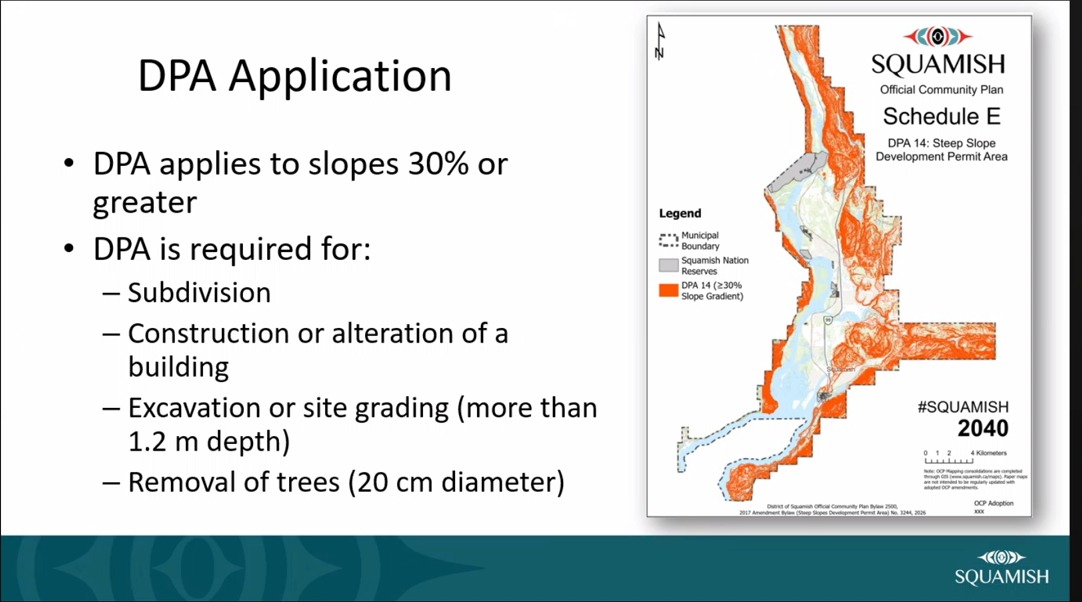
Adopted with no one opposed: a permit and an engineer's check for building on land at 30% slope or steeper. The old "no building over 40%" rule is gone.Passed unanimouslyNew rules for building on steep slopes✓✓✓✓✓✓✓Passed unanimouslyStaff to approve steep slope permits✓✓✓✓✓✓✓
In short: Building on land at 30% slope or steeper now needs a permit and an engineer's landslide check, approved by staff rather than council. The old ban on any building over 40% is gone. Existing homes on small lots are exempt.
Passed All 7 there agreedNew rules for building on steep slopes
What it means for you: Existing single family homes are exempt for minor changes; the rules apply to new building, large digging and cutting trees 20 centimetres or wider on steep slopes.
Squamish council voted to adopt a change to the that creates a steep slopes area (a zone where builders need an extra permit showing they meet set guidelines). It covers most slopes of 30% or steeper and requires things like a hazard check by a geotechnical engineer. Staff said this finishes the last of six steps the plan required before development on some future neighbourhood lands could be considered, but does not approve any development there.
From the meeting video. We check it against the official minutes when they come out, usually a few weeks later. Under B.C. law, a member who is in the room and does not vote is counted as voting yes (Community Charter section 123(4)).
Part of: Official Community Plan update and growth
Why it matters: It sets safety, drainage and visual rules for hillside building as Squamish looks to higher ground.
Passed All 7 there agreedStaff to approve steep slope permits
Squamish council voted to adopt a bylaw letting District planning and engineering staff, rather than council, approve steep slope permits. This matches how flood, wildfire and environmental permits are already handled.
From the meeting video. We check it against the official minutes when they come out, usually a few weeks later. Under B.C. law, a member who is in the room and does not vote is counted as voting yes (Community Charter section 123(4)).
Council gave final approval to a new steep slope permit area in the Official Community Plan, the town's long range land use plan. On land with an average slope of 30% or more, you now need a permit, with a landslide hazard assessment by a qualified engineer, before you subdivide, build, dig or fill more than 1.2 metres, or cut trees 20 centimetres or wider. Lots of 0.2 hectares or smaller (about half an acre) that already have a house are exempt, and so is minor work. Private strata roads must now meet the District's public road grades, because steep roads slow down fire trucks.
The bylaw also removes older limits from the plan: a slope report at 25%, no new single family houses on slopes of 25% or more, and no development at all over 40%. Staff said those caps didn't fit Squamish's short, rocky bluffs, and that the engineers they consulted saw "not a strong hazard mitigation rationale" for limits based on steepness alone. Not everyone agreed. An open house comment asked for a slope limit "above which development is not supported"; a third of the 45 spring survey replies called the visual design guidelines too onerous; and developers called the 30% line "too blunt". At the October public hearing, the one resident who spoke worried about how much rock and soil could be removed.
A planner said this finishes the last of six steps the 2018 plan requires before two future neighbourhood areas could be considered: District Lots 509 and 510 in the north, and land near Valleycliffe and the Mamquam area in the south. It does not approve any development there; each would still need its own applications. Hillside risk is real here: the new Cheekye debris flow barrier north of town cost more than $115 million, and a 2024 landslide in Lions Bay killed two people.
| Place | Where extra rules start |
|---|---|
| Squamish, new rules | Average slope 30% or more |
| Squamish, old rules (removed) | Report at 25%; no single family houses at 25%; nothing over 40% |
| District of North Vancouver | Over 20 degrees (about 36%) and over 10 metres high |
| Surrey | Over 20% |
| Colwood | Development on slopes over 30% "must be avoided" |
Council also passed a second bylaw letting District staff, not council, approve these permits, the same way flood, wildfire and environmental permits are handled. Both passed with no one opposed. Only Andersen was on council at the October 6 public hearing. BC law lets members who missed a hearing vote on adoption once they get a report of what was said, and staff reminded the new council it can't take in new information on a bylaw after its hearing.
Flood plan grant
Approved with no one opposed: the District asks the Province for up to $200,000 toward updating its 2017 flood plan.Passed unanimously✓✓✓✓✓✓✓
In short: The District is asking the Province for up to $200,000 toward a $400,000 update of its 2017 flood plan. Staff said a Squamish River dike breach could displace over half the town.
Passed All 7 there agreedGrant application for the flood plan update
What it means for you: The $400,000 update is already budgeted from District savings for 2027 and 2028; a grant would lower the District's share.
Squamish council voted to apply for a provincial Community Emergency Preparedness Fund grant to help pay for updating the District's Integrated Flood Hazard Management Plan, its main guide for managing floods. The District will ask for up to $200,000, or $100,000 under a second category, and can win only one.
From the meeting video. We check it against the official minutes when they come out, usually a few weeks later. Under B.C. law, a member who is in the room and does not vote is counted as voting yes (Community Charter section 123(4)).
Part of: Dikes, flood protection and the Cheekeye barrier
Why it matters: Most of Squamish sits in a floodplain, and the update will reset priorities for dike upgrades and flood rules.
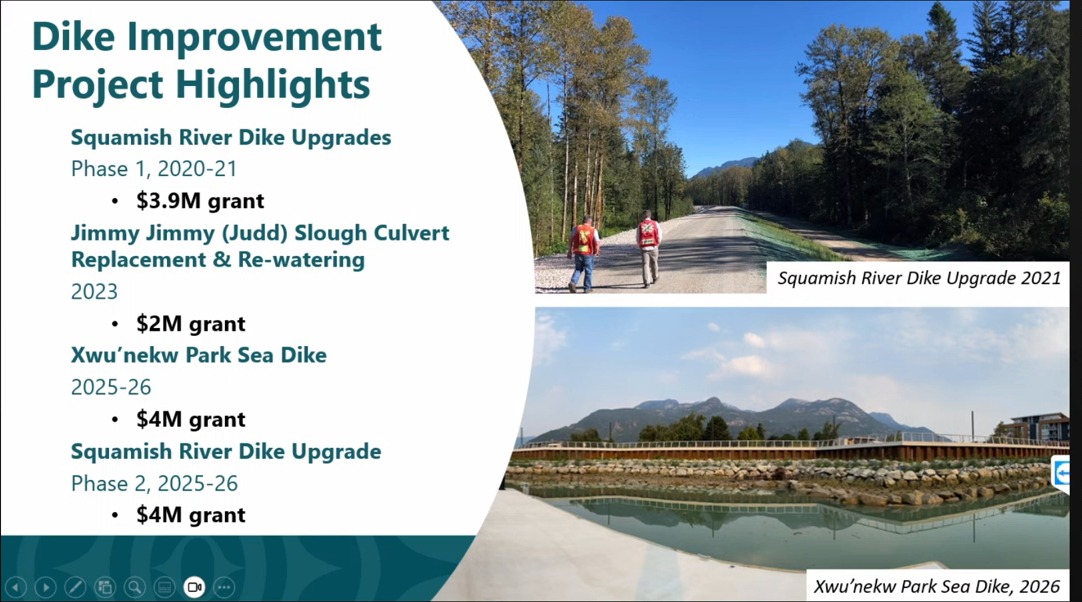
Squamish faces flooding from five river systems and the ocean, and its Integrated Flood Hazard Management Plan, the town's main guide for dikes and flood rules, dates from 2017. It's due for its 10 year update, already budgeted at $400,000 from District reserves over 2027 and 2028. Council voted, with no one opposed, to apply to the Province's Community Emergency Preparedness Fund for up to $200,000, with a $100,000 ask in a second category as a backup; the District can win only one.
The stakes are high: engineering staff said a Squamish River dike breach "could displace over half of the community's residents and cause hundreds of millions of dollars in direct building damage." The District has won about $14 million in flood grants since the 2017 plan. Engineering staff said the new plan would move from mapping hazards to weighing risk, including sea level rise and new costs for dike upgrades. The application is due Friday, November 20, and staff expect an answer in March 2027; the program warns it will be heavily oversubscribed. It comes days after flooding washed out Squamish Valley Road and cut off the upper valley.
Election report
Turnout was 45.33%, up from 39.73% in 2022. A second election day voting place is likely by 2030.Passed unanimously✓✓✓✓✓✓✓
In short: 45.33% of eligible voters cast a ballot in October, up from 39.73% in 2022 and well above the BC average.
Passed All 7 there agreed2026 election results report
What it means for you: Staff expect to need a second voting place on election day in 2030, as Brennan Park was busy.
Squamish council voted to receive the Chief Election Officer's report on the October 2026 election. Turnout was 45.33%, about 2% below Squamish's long term average but well above the provincial average of 29.2%.
From the meeting video. We check it against the official minutes when they come out, usually a few weeks later. Under B.C. law, a member who is in the room and does not vote is counted as voting yes (Community Charter section 123(4)).
The corporate officer, who was also the chief election officer, reported on October's vote. Turnout was 45.33%: 8,881 of 19,591 eligible voters, up from 39.73% in 2022 and well above the 29.2% BC average staff cited. Ballots cast rose about 32% from 2022 while eligible voters rose about 16% (our arithmetic). Advance voting rose to 2,932 people. Mayor Easton won by 175 votes. The election had a $120,000 budget, and staff expect Squamish will need a second election day voting place by 2030.
2026: 45.3%. 8,881 of 19,591 eligible voters
Who spoke, and for how long
Staff spoke the most, about an hour. Among council, the mayor and Councillor Andersen, who each chaired part of the meeting, spoke longest. The tax freeze and co-living took about 40 and 27 minutes.
Staff, guests and the public
Councillor Andersen chaired the co-living item while the mayor was out, so part of his time was chairing too.
- Welcome and acknowledgement 1 min · from 6:35
- Adoption of agenda <1 min · from 7:59
- Public attendance (none) 1 min · from 8:21
- Consent agenda <1 min · from 9:48
- Co-living business licence bylaw 27 min · from 10:32
- Steep slopes OCP bylaw 27 min · from 37:08
- Steep slopes permit delegation 1 min · from 1:04:14
- 2026 election results report 9 min · from 1:05:35
- Flood plan grant application 30 min · from 1:14:51
- Mayor's budget notice of motion 40 min · from 1:45:08
- Open question period 1 min · from 2:25:11
- Council announcements 7 min · from 2:26:13
- Termination <1 min · from 2:32:58
How would you have voted?
Four quick yes or no questions, then see which council member voted most like you.
Four quick questions, one for each vote council took on November 17. Answer them and see which council member voted most like you.
Vote 1 of 4
Would you have voted to move co-living licences ahead?
Licences and inspections for co-living homes under the rules adopted in October.
Vote 2 of 4
Should council have paused co-living to rethink it in strategic planning, as Councillor DesJardins asked?
It failed 2 to 4.
Vote 3 of 4
Should council have adopted the new steep slope rules?
They add an engineer's landslide check but drop the old "nothing over 40%" limit.
Vote 4 of 4
Should the District apply for the flood plan grant?
Up to $200,000 toward a $400,000 update, which comes from reserves otherwise.
Who on council voted most like you?
Answer the 4 questions above and your match appears here.
What happens next
December 1: the tax freeze debate. Still to come: council's vote to adopt the co-living bylaw and an answer on the flood grant in March.
- December 1, 6 p.m.: council debates the tax freeze motion, with the staff memo on costs and options. Write to council before then at council@squamish.ca, or send budget ideas to budgetfeedback@squamish.ca.
- Co-living licences: council's vote to adopt the bylaw, at a future meeting.
- Flood grant: application due November 20; an answer expected in March 2027.
- Budget: the District plans public input on the 2027 financial plan, which staff aim to finish by the end of March. By law, the financial plan comes before the tax rate bylaw, which must pass before May 15.
Watch any meeting live on the District's YouTube channel, or join by WebEx or phone (1-604-449-3026). Our meeting page has the full summary and transcript.